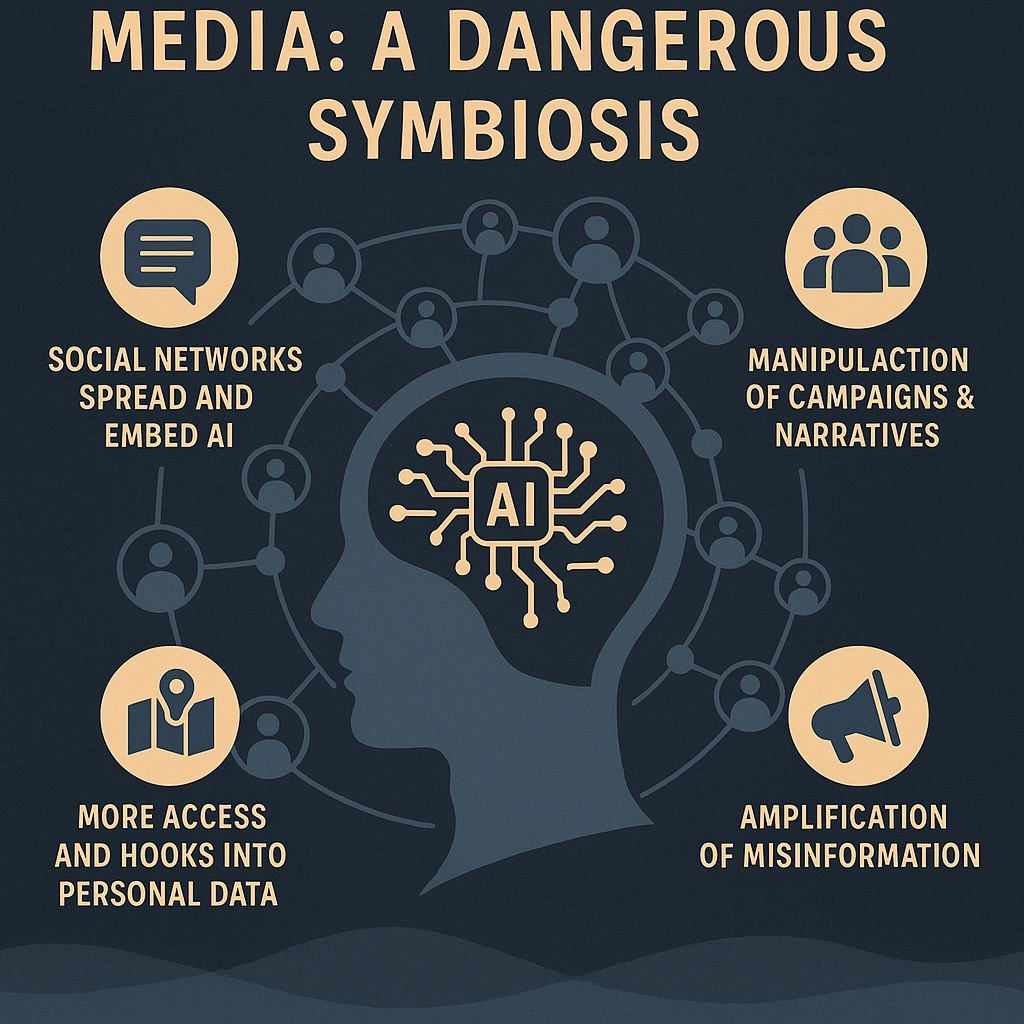
Artificial Intelligence (AI) is poised to embed itself more deeply within social media ecosystems, creating unprecedented opportunities and significant risks. Social networks, once limited to human connection and content sharing, are now becoming prime real estate for AI proliferation. This evolution is fueled by advancements in data processing and contextual understanding, combined with the vast social graphs that platforms like Facebook, Twitter (now X), Instagram, and emerging networks offer. However, with this transformation comes a set of ethical, social, and regulatory challenges, particularly as misinformation campaigns continue to exploit these spaces.
AI’s Social Media Invasion
Social networks have always been about connections — weaving digital circles where individuals can communicate, share, and build communities. In the early days, as highlighted by Running in Social Circles, social networks operated within relatively simple and organic structures. Users maintained circles of friends, acquaintances, and interest groups, with each network serving as a unique hub for personal or professional interaction.
Today, the structure has shifted. AI is leveraging these interconnected graphs to spread and embed itself. Platforms are increasingly relying on AI to produce and recommend content, manage moderation, and even create synthetic influencers. With tools like Notebook LM, AI-driven podcast content is already emerging, offering users highly personalized audio experiences. By leveraging enriched data, such as location-based maps and personal contacts, AI can tailor content more precisely than ever before.
The MidJourney and Discord Symbiosis
One of the most fascinating modern examples of AI leveraging social media is MidJourney’s integration with Discord. By using Discord as its primary interface, MidJourney not only harnessed a platform already centered on community engagement but also fostered a creative social network where users actively share their AI-generated art. This approach was innovative because it built a self-sustaining community where content creators naturally became promoters of the platform, forming a social network around AI-generated art. Unlike traditional social media, where content often feels disconnected from creation, MidJourney’s Discord-centric model inherently ties production with community interaction, allowing creativity to thrive in a social setting.
AI Slop: Quality vs. Quantity
A major concern that arises from AI’s dominance in social media is what some critics call “AI slop.” Many associate AI slop with images, because that is the most readily discernible format, but that same slop is present in written, spoken, and musical formats as well. As AI-driven content becomes pervasive, the quality of output can degrade, often appearing formulaic, generic, or contextually flawed. This phenomenon arises when AI models are trained on vast but inconsistent data, producing content that is both omnipresent and underwhelming. Social media platforms are particularly susceptible to this, as algorithms favor volume over depth, amplifying AI-generated content that lacks originality or coherence. If left unchecked, the prevalence of AI slop risks eroding the perceived value of AI-generated media, making quality curation more challenging for users.
Data-Driven Personalization vs. Manipulation
While the idea of highly personalized content sounds beneficial, it also introduces a darker aspect: manipulation. AI thrives on data — the more personal, the better. Social media giants are incentivized to gather vast amounts of user information, which in turn fuels algorithms that predict behavior and influence decision-making. This data-driven approach is not inherently problematic until it intersects with political manipulation.
During the 2016 and 2024 election cycles, social media became a battleground for misinformation, as unregulated data harvesting allowed malicious actors to create hyper-targeted campaigns. AI is poised to make this even more sophisticated. By bridging data analytics with automated content generation, AI can shape narratives with an unprecedented level of nuance. Campaigns leveraging AI can simulate genuine human dialogue, generate fake grassroots support, and even manufacture deepfake videos to support political agendas. And anyone utilizing AI to boost their efforts is going to be light years ahead in their planning over those that do not.
Concluding Thoughts: A Call for Regulation
As AI continues to infiltrate social media, the line between authentic human interaction and algorithm-driven manipulation blurs. To prevent AI from being weaponized within these platforms, it is essential to establish regulations that hold tech companies accountable for AI-driven content generation and data usage. Transparency is crucial: users must know when they are interacting with a human or an algorithm and how their data shapes the content they see.
AI’s social media integration is inevitable, but without clear ethical guidelines and regulatory oversight, the next wave of social networking may become a powerful tool for manipulation rather than connection. As AI shapes our digital circles, we must remain vigilant to ensure it serves humanity rather than subverting it.

 Playing with Sharp Objects.