Oh, mamma mia, mamma mia (Mamma mia, let me go)
Beelzebub has a devil put aside for me, for me, for me
-Queen
From Vatican Morality to Zeroes and Ones
In the ongoing march of advancement and improvement, humanity occasionally finds itself at points where extraordinary potential meets profound ethical risk. The timely releases of moral guidance from the Vatican and calls for concrete regulation of AI underscore the eternal challenge of shepherding power, always unprecedented in its time, toward benefiting the common good without sacrificing the fundamental, inalienable dignity of the human person. They also raise philosophical questions about how we can separate the idea of human value from our individual labors, or what it even means to be a human being without the need for labor. Underneath it all are ancient, existential terrors: the fear of change, the fear of a faceless thing that can replace us, the fear of being worthless or useless, the fear of living in a world not ours to control or even understand. The answer lies somewhere in deep, historical reckoning between the limits of human ambition and the default idea that idle hands are the devil’s workshop.
The Enduring Weight of Rerun Novarum
The critical nature of this dialogue is not new. The publication of Rerum Novarum by Pope Leo XIII in 1891 came as the industrializing world wrestled with the raw forces of unbridled capitalism and the burgeoning class conflict. Strangely enough, the idea of industrialization had begun with the mass production of the Gutenberg bible on the newly born printing press, when the bible was considered to be the height of wisdom, and enlightening the masses on a scale unseen created radical change. The idea that printed books would ruin memory and destroy scholarship sounds a lot like what we see today with the fear of AI, but there is a difference. These periods of change cause a great deal of disruption that many do not recover from in their lifetime. The First and Second Industrial Revolutions had transformation periods of 40 years each. The Information Age, sometimes called the 3rd industrial revolution, caused disruptions in various industries from the 70s through the 90s with the advances in factory robotics and information compilation. Today we are looking at lights-out factories, robots that can help in homes, programs that write themselves, and automation that requires vastly fewer humans.
Somewhere between the freshly dehumanizing meat mill of the American Civil War and the run-up to Powderkeg Europe, Rerum Novarum did not merely offer spiritual solace but fundamentally shaped modern socio-economic thought, laying the groundwork for sectors of modern social teaching. At a time when workers were seen as disposable, it provided a powerful moral defense of labor unions, legitimized state regulation to protect workers, and established a “third way” alternative to both unregulated capitalism and state socialism. Introduced into a world dominated by a zero-sum view of labor, it affirmed the inherent dignity of labor, established the doctrine of social justice, and provided a moral counterbalance to the era’s economic determinism. Rather than being a gentle suggestion, it was a forceful intervention that ensured the spiritual life of the Church would forever be tethered to the concrete, often difficult realities of human work and economic struggle. It unfortunately aligned with the words of socialists in an age when those texts were associated with violence and upheaval, and thus an enemy of capital, polarizing us even in the world today.
Power imbalances across eras consistently reveal deep moral challenges, generating tensions that call for change. Today, this tension exists between technological and economic power and fundamental human rights. The Industrial Revolution’s history demonstrates that increasing productivity must go hand in hand with safeguarding workers’ inherent worth is protected. To paraphrase a certain Dr. Iam Malcolm, just because you could do a thing, preoccupied by it one might say, does not mean it should be done.
Up The Lattice: The Abdication of Power or The Soul?
Today, the challenge is more subtle, more invasive, and arguably more profound. Large-scale projects such as transcontinental nations, massive space programs, or global AI frameworks are fundamentally exercises in concentrated power. Every concentration of power demands a transaction: the voluntary or involuntary abdication of some rights and freedoms. The further up the lattice of society we climb—the higher the political or technical abstraction—the more our individual agency and rights feel negotiable, almost willingly surrendered. At a bare minimum, you feel it every time you browse the web, scroll through social media, or blindly click OK on that third terms-of-service agreement, with you as the product, not the end user. Bit by bit, it gets chipped away.
The gravest sin, therefore, is not merely political overreach but the psychological capitulation that reduces the complex, unquantifiable reality of a human life to mere data points. The most damaging form of modern power is the one that treats your fellow human not as a full person but as zeros and ones.
Throughout history, atrocities often required a moral framework that first categorized people before reducing them to commodities, enemies, statistics, or obstacles. Slave records reduced humans to inventory lists. Colonial systems turned populations into census data and labor units. Totalitarian regimes classified citizens by ethnicity, productivity, or political risk. The initial shift always involved language: from neighbors to stock, from families to parasites, from dissenters to destabilizers. What digital technology has introduced is increased speed, detail, and automation, all of which are similar to what IBM achieved during WWII.
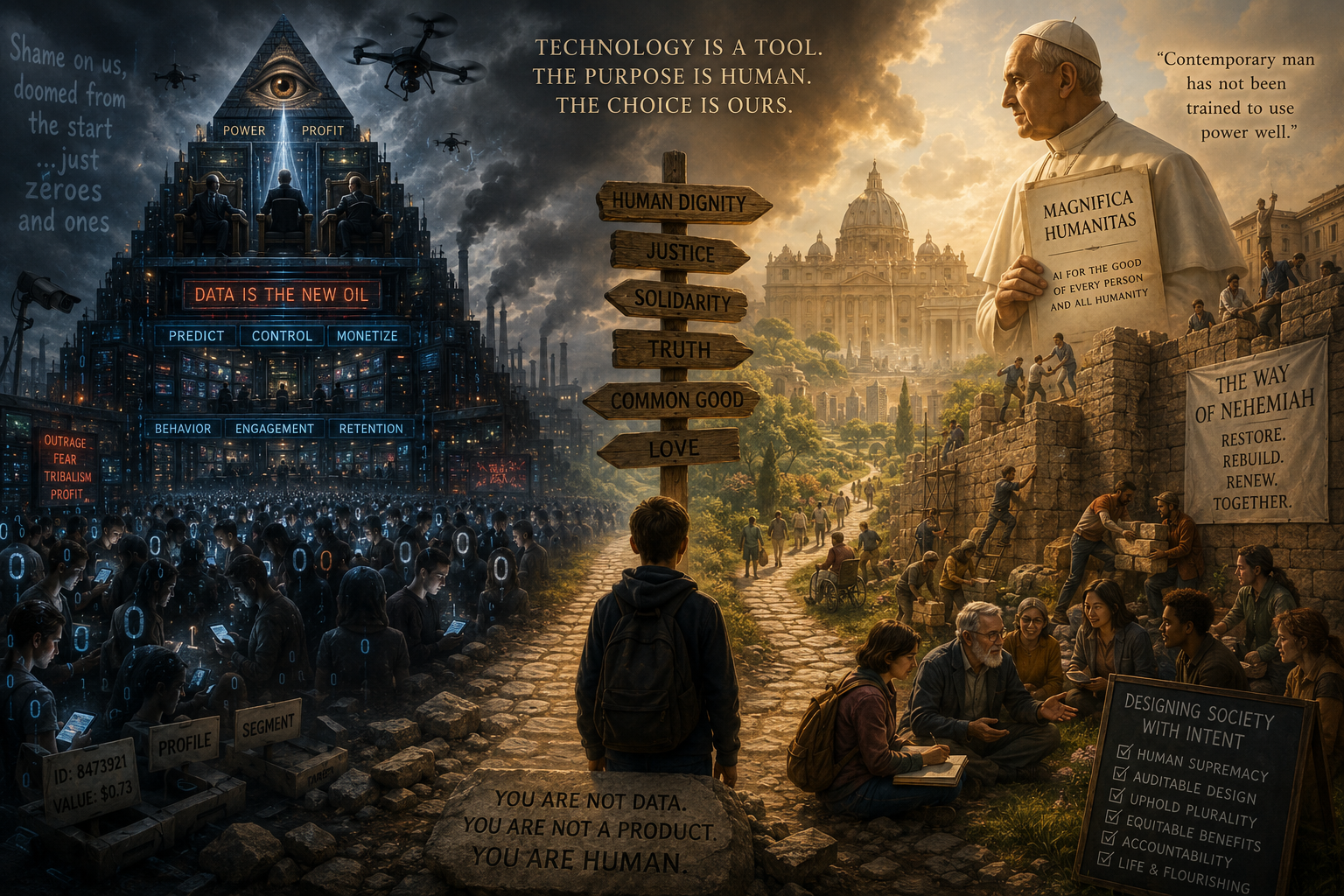
Modern platforms don’t need explicit hatred to create comparable outcomes. They can do so through optimization, turning individuals into behavioral profiles, engagement signals, retention metrics, ad segments, or inputs for recommender systems. When people are viewed mainly as machine-readable abstractions, systems start making decisions about them instead of for them. The danger lies in the moment when human complexity becomes operationally inconvenient, when metrics seem more real to institutions than actual experiences, when scale eliminates interpersonal friction and moral transparency, and when optimization takes precedence over accountability. This is something Mark Zuckerberg’s Meta has proven useful to them in the US, India, Myanmar, and Sri Lanka. The Vatican frames it as a potential Tower of Babel, but I see it as a symbolic pyramid with many at the bottom and many pharaohs at the top.
In past atrocities, othering often relied on ideology, whereas today, it can stem from infrastructure itself. Algorithms don’t need to “hate” populations to escalate sectarian violence in Myanmar or polarization in India; they only need to find that outrage, fear, tribalism, and humiliation boost engagement. The system views social instability as a profitable side effect rather than a moral concern; this indifference being the opposite of what some held as their motto, “Do No Evil”. This echoes historical patterns: chattel slavery reduced humans to economic units, industrial extermination utilized administrative abstraction, and modern surveillance capitalism relies on behavioral abstraction. All these mechanisms serve to compress human beings into manipulable representations, necessary in the short term for computation tasks, but vile when used to manipulate through advertising and misinformation. The common thread is the removal of reciprocal humanity; once a person becomes data, category, or target, moral distance grows, and that’s often where large-scale abuses begin. The unsettling implication is that modern systems can reproduce historical atrocities without explicitly monstrous individuals. A bureaucracy, platform, or model can cause harm simply by relentlessly pursuing efficiency, growth, prediction, or engagement, treating humans as disposable input to manage. This might be the greatest danger of the digital age: it’s not that technology makes people inherently evil, but that it makes it easier to see others as fundamentally unreal or invisible. An unchecked march driven by AI towards human extremes, if poorly stewarded, could lead to even darker lows, sacrificing lives and humanity.
As a former Catholic, this sentiment is captured by Nine Inch Nails’ “Zero Sum,” which rings with chilling accuracy as a counterpoint to the digital age’s promise of “perfection”:
Shame on us, doomed from the start
May God have mercy on our dirty little hearts
Shame on us for all we have done
And all we ever were, just zeroes and ones
It strikes me as shocking that the words of sanity come from the institution that looked the other way during WW2, only this week apologized for not condemning slavery during its height, and whose ancient coffers have been bled dry by sexual scandals. Despite all that, there are still valuable nuggets of human wisdom. When we allow our ethics to be dictated by algorithms that prioritize prediction over personhood, we risk creating a flawless yet utterly soulless, sterile system. What good is AGI if there is nothing resembling a human in command of it? And what else will we leave behind in the coming centuries?
Daemons
The strange part is not that the Vatican entered the AI debate, but that no other large organizations in the business of moral authority did. Governments talk about competitiveness, venture capital talks about acceleration, and executives talk about productivity curves and shareholder value. Most of the public conversation is engineers arguing over joules and vectors, with nobody knowing where the roadmap really leads. There is an easy instinct to dismiss the Church here, as hokum led by people in robes who comment on systems they barely understand. Silicon Valley has spent decades treating religion as an obsolete compatibility layer waiting to be deprecated by computation. Faith in the algorithm was always going to compete with faith in God because both attempt to answer questions of uncertainty, meaning, prediction, and control. Rather than the rituals of faith systems, our digital networks simply arrived wrapped in mathematics and processes, some of which we take as flawless despite knowing that every one of these systems is buggy, getting us in trouble when the system is too sycophantic.
But religion gave us something else in the past. With its promise of rewards in the afterlife, it inspired us to build higher, further, and faster with each generation, benefiting those to come. The Sagrada Família has been under construction since 1882 and was finally completed this year. The original visionaries, Gaudi and Villa, knew that something of that scale would not be finished in their lifetimes; they built so that future generations would benefit from this house of faith. Projects that require a long view have an impact that reaches across time, to people that even one’s grandchildren would not see. While the path to AGI will be far shorter than that, its impact will reach those to come, and we now have wisdom, painfully earned, that can guide us with compassion for those who will not know a world without AI.
“We can care deeply – selflessly – about those we know, but that empathy rarely extends beyond our line of sight.” -Dr. Mann
The criticism from Rome is not entirely irrational. Whatever you might think of theology, its rituals and traditions are essential human elements that are often absent from the tech world. Religious institutions still hold a collective wisdom that can be valuable. The tech industry frequently treats AI progress as a moral good, assuming that greater capability equals greater wisdom, but history shows otherwise. Human history proves that power grows faster than our ability to control it. Nuclear weapons, industrial warfare, surveillance states, and social media algorithms all appeared before society fully understood their impact. We tend to build first and comprehend later—sometimes after many generations. The line “contemporary man has not been trained to use power well” from the document emphasizes the point, cutting directly through any mythology surrounding AI development. We like to imagine that intelligence naturally produces maturity, but technical sophistication and moral sophistication are not the same thing.
The document keeps returning to the same unresolved questions. How do poor nations actually benefit from AI instead of becoming extraction zones for data and labor? Is it easier to dismiss all this when you have quotes like “the poor you will always have with you”? What does human flourishing even mean when machines can imitate thought, art, and conversation? What exactly are we building when the systems increasingly derive their behavior from us, from our language, our biases, our fears, our obsessions? AI systems are trained on humanity at scale, made from us and our words, which should probably concern us more than it seems to. What does it mean to amplify Human?
The paper also attacks one of the central fantasies that holds the industry together: the idea that automatic prosperity will simply emerge from growth in capability. It calls that promise illusory, and honestly, history backs that skepticism. Industrialization created enormous wealth while also creating child labor, exploitation, pollution, monopolies, and entire classes of disposable workers. We’ve done this in modern times with the mass move to offshore labor over the past 20 years and the messy growth that came with it. The internet connected the world while concentrating power into a handful of platforms. There is no natural law stating that AGI benefits get distributed fairly. Somebody codes the algorithm, trains the model, designs the incentives, owns the infrastructure, and decides who matters. These engineers, directed by the very few seeking to improve the monolithic business they are steering, or even now by the monetary returns of public offerings, do not have ethics at the top of their minds.
That is where the warning starts becoming darker. AI does not emerge into stable democracies filled with thoughtful citizens calmly evaluating tradeoffs. It emerges into societies already strained by polarization, populism, economic anxiety, algorithmic manipulation, and a growing appetite for authoritarian certainty. Unthinking populism tied to growing fascism creates fertile ground for systems optimized around control instead of dignity. Recommendation engines already proved how quickly human beings can be fragmented into tribes that barely recognize each other as people.
When the frontier model companies announce that they have hired AN ethicist, the whole spectacle starts to feel like a strangely theatrical distraction, Scaramouche dancing on the head of a pin while the crowd mistakes fandango for wisdom and action, projecting certainty within systems nobody fully understands. It sounds absurd until you realize how much modern technological culture runs on confidence and branding, and on the illusion that somebody is actually in control of the machine. Social media algorithms we took for granted for decades are only now being taken out of the hands of our vulnerable youth because we had to learn the hard way rather than think through the ethics ahead of time. However necessary, adding ethics to the formula at this stage seems like a blend of performative concern and capitulatingly late. Better late than never?
The Vatican’s Call and the Blueprint for Humanity
Pope Leo XIV’s Magnifica Humanitas confronts this head-on. The encyclical does not fear technology; rather, it demands that we resist the siren song of the “technocratic paradigm.” The Vatican warns that AI is not inherently evil, but is never neutral. Like any tool or technology, it absorbs the character of those who devise, finance, wield, and regulate it. The goal, therefore, is not to outlaw intelligence, but to redirect its purpose back to the “common good.” To steer it in the right direction rather than letting it act as a wheel of fortune for humanity.
The Catholic Church’s wisdom, rooted in its Social Doctrine, guides us toward a vision, “the way of Nehemiah,” a model of holistic, community-led restoration based on a biblical story of Nehemiah rebuilding the walls of Jerusalem. In modern frameworks, it describes a regenerative approach to organizational leadership, urban planning, and community development that focuses on repairing systemic brokenness and restoring local vitality. In the AI frame of reference, this means cultivating an intentional society where every system, every policy, and every line of code must be designed to enhance, not undermine, human flourishing.
Designing Society with Intent
The cumulative wisdom from Rerum Novarum‘s economic reforms to this Pope’s moral compass, and the critique of the “zeros and ones,” demand a radical shift in the collective human ethos, from tribalism and merely reacting to technology’s consequences to proactively designing our society with a moral, human-centered intent. For that, we must understand where we want to go, envision our destination in harnessing sails to this digital vessel of intelligence, and put regimented order and discipline in place as guardrails for that future. That entails connecting with ethicists and philosophers and having a deep understanding of morality. Given the state of the world today, that challenge may be harder than ever, as polarization means agreement is almost impossible.
It will also require translating all of our aspirations into concrete, enforceable limits. The “Bill of Limits on AI Rights” is not just a technical document; it is a societal mandate. It insists on:
- Human Supremacy: AI must be a tool for humanity, forever subservient to human ethical oversight, possessing no rights of its own beyond those granted by its creators.
- Auditable Design: The capacity for independent, public review—a perpetual ethical audit—must be baked into the very foundation of artificial systems.
- Upholding Plurality: Recognizing that the messy, discordant input of diverse human perspectives is not a bug to be fixed or anomalies to be smoothed out, but the central resource for progress.
The recent call by Anthropic to pause is itself interesting, since they stand to lose the most by it at this time, potentially conceding the lead to OpenAI or even a foreign competitor. But this mentality of conflict and competition is exactly what has led us where we are today. The ultimate purpose of technological advancement must be to foster the “civilization of love,” or at minimum a “civilization of life”, a state in which the highest measure of success is not GDP or processing speed but the quality of life, human connection, and justice. There is no currency that quantifies any of that, so I have no illusions that the human race will suddenly pivot on this idea. While not rejecting AI, we must begin by actively rejecting the false promise of singularity, of a life perfected into pure data, and instead embrace the glorious, messy, and irreplaceable reality of the embodied human being as divine in its own right, and decide with intent where our intelligent creation can augment us. The magnificent human future, therefore, is not a product of pure intelligence, but of purified human intention. And you won’t be able to participate in that while doomscrolling as a product of the algorithm.