Why AI Should Serve Us, Not Replace Us
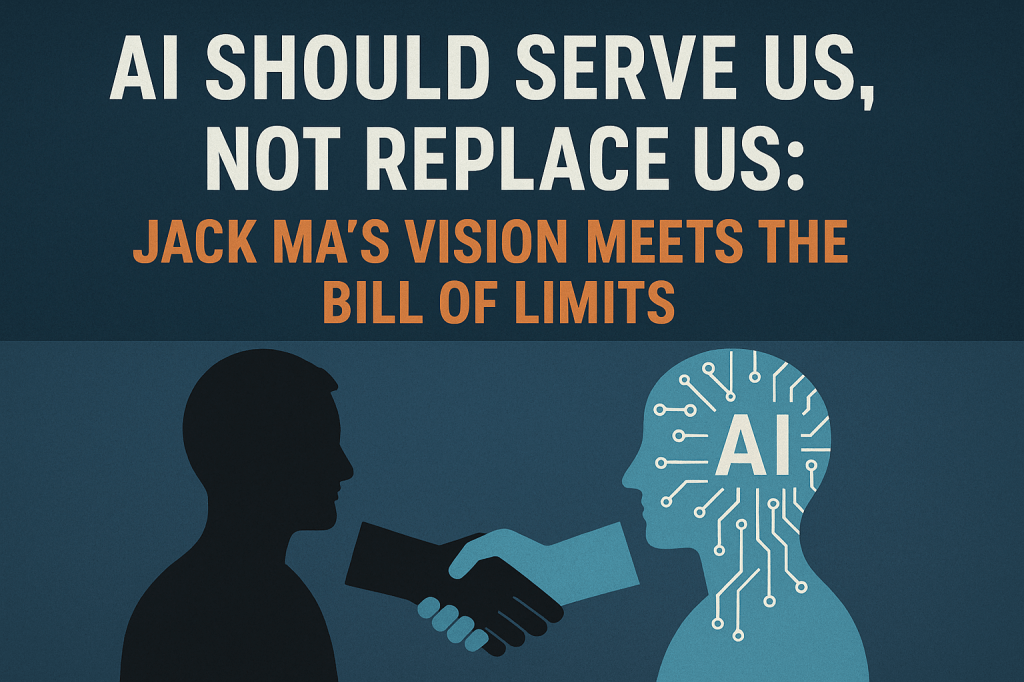
As the author of the Bill of Limits on AI Rights, I’ve spent some time thinking about what artificial intelligence should never become. We are in a pivotal moment in human history where the capabilities of machines are beginning to blur the lines between tool and entity, between assistant and autonomous actor. That’s why I crafted a document that outlines hard boundaries—rights AI should never have, powers it must never acquire, and principles that put humanity firmly in control.
So when Jack Ma recently spoke out about the need for AI to “serve humanity, not dominate it,” I was both encouraged and wary.
Jack Ma’s Vision: Ethical, but Incomplete
Jack Ma’s re-entry into the conversation on AI ethics is a welcome one. As a globally recognized tech leader, he commands attention—and his call for AI to serve human dignity, not erode it, is absolutely right. He advocates for responsible innovation, human-centric design, and the development of AI that supports, rather than supplants, people in their lives and work.
But while his stance is noble, it stops short of establishing the kind of guardrails we urgently need. His vision depends heavily on voluntary ethics and the goodwill of developers and corporations. There’s no mention of enforceable limits, no structural failsafes, and no clarity about what happens if those in power simply choose not to act in humanity’s best interest.
That’s where the Bill of Limits draws the line.
A Bill of Limits: Hard Lines in a Fluid World
The Bill of Limits on AI Rights is not a philosophical suggestion. It is a blueprint for survival. It sets out unambiguous restrictions on what AI systems must never be allowed to do: own property, impersonate humans, create other AIs, or gain rights normally reserved for living beings. It demands the presence of human-controlled override systems and insists on transparency so that no machine can pass as a person in any setting—legal, political, or social.
It is not enough to hope that AI serves us. We must legally ensure that it cannot do otherwise. We must define the ultimate guardrails.
Contrast in Philosophy
Where Jack Ma sees AI as a partner to be guided, I see a power to be constrained. His outlook relies on cooperative alignment between human values and machine learning. Mine accepts the possibility—if not the inevitability—that AI will, at some point, operate outside those values unless we establish strict boundaries now.
He urges designers to build AI with compassion. I urge lawmakers to deny AI any pathway to personhood, agency, or self-propagation.
This is not pessimism. It is prudence.
Ethics Must Be Enforced
Ethical AI, without enforceable limits, is wishful thinking. History has taught us that good intentions are no match for profit motives, national competition, or technological momentum. We’ve seen what happens when industries self-regulate. It doesn’t work—not for the environment, not for data privacy, and certainly not for systems capable of recursive self-improvement.
We need both ethics and law. Principles and policies. Visionaries like Jack Ma can help drive the former. But it will take documents like the Bill of Limits to deliver the latter.
Jack Ma is right: AI should serve humanity. But good intentions alone won’t keep machines in their place. Without hard limits, we risk creating entities we cannot fully understand—let alone control. The Bill of Limits is not a rejection of AI. It is a commitment to humanity’s primacy in a world that is rapidly automating.
And if we are serious about making sure AI does not dominate us, we must do more than dream of ethical futures—we must write them into law. Humans must be the ones to ultimately hold the power cord in case something isn’t right.

 Playing with Sharp Objects.