A Familiar Fear, Reborn
In the early 19th century, a group of English textile workers known as the Luddites took up arms—not against people, but against machines. They destroyed looms and weaving technologies they believed threatened their livelihoods. Their rebellion wasn’t anti-technology—it was a protest against how technology was being used: to displace skilled labor, exploit workers, and consolidate power without offering social support.
Today, that unease is reemerging. This time, the machines are invisible—lines of code and generative models. But the tension remains. Artificial Intelligence is rapidly reshaping industries, workflows, and human roles. And while no one’s smashing servers (yet), the resistance is real—manifesting in protests, legal challenges, ethical debates, and growing public distrust of corporate AI initiatives.
Old Patterns, New Tools
Back then, factory owners profited while skilled weavers were cast aside. The machinery wasn’t about progress—it was about profit. And the workers were right to be skeptical.
Today, coders, creatives, lawyers, and even doctors face potential displacement or forced collaboration with AI. The fear has moved up the value chain, from blue-collar to white-collar professions. Once again, it’s the powerful who stand to benefit—tech giants led by billionaires who now consolidate immense wealth and control. The societal impact? Still largely unaddressed.
The Luddites could point to a loom and say, “That’s what’s replacing me.” We’re left pointing to opaque algorithms in the cloud—systems that decide who gets hired, who receives a loan, who goes to jail. The threat feels abstract, even existential. And unlike industrial automation, which played out over decades, AI is evolving at breakneck speed.
Even industry leaders once seen as untouchable—like Apple—are struggling to find their footing in the AI race.
This Is About Control, Not Just Innovation
Like the Luddites, today’s critics of AI aren’t anti-progress. They’re pro-accountability, pro-dignity, and pro-agency. The question isn’t whether we should build AI, but who controls it—and to what end.
In the 19th century, it was factory owners. Today, it’s a small circle of tech billionaires—some of whom wield enormous influence not just over industry, but over policy and public perception. Many have aligned themselves with populist politics, including the Trump administration, using anti-establishment rhetoric while benefiting from establishment systems.
By doing so, they frame AI disruption as “inevitable innovation,” dismissing ethical concerns as roadblocks to progress. Critics are labeled alarmist, anti-tech, or anti-freedom—just as the Luddites were unfairly caricatured as irrational machine smashers.
These political and economic alignments have consequences:
• Fewer safeguards for the public good
• Lack of transparency in how AI is built and deployed
• Greater consolidation of wealth and power
• A growing gap between AI developers and those impacted by their tools
• A culture that discards dissenters as obstacles
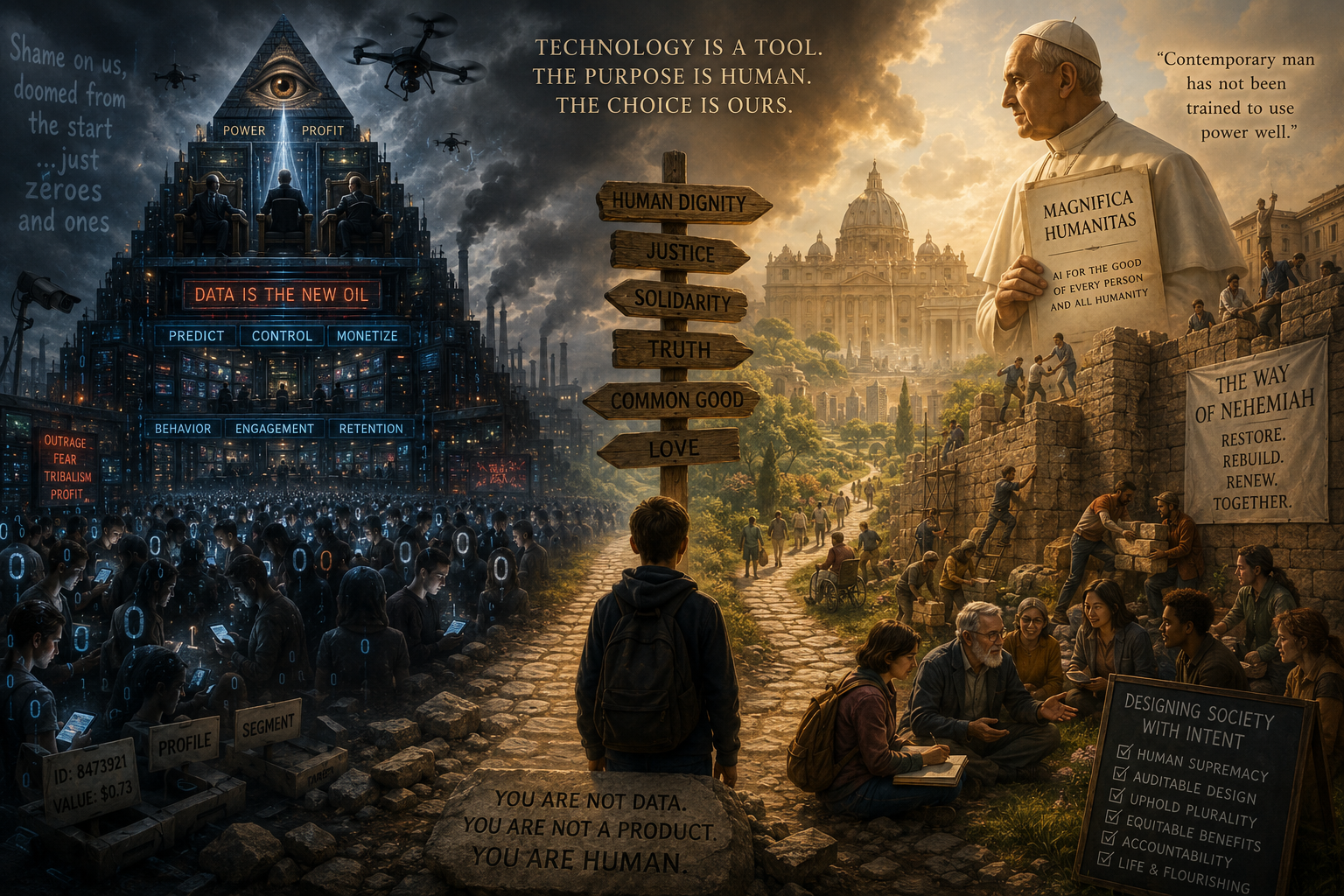
This isn’t innovation—it’s techno-feudalism, where a few powerful actors control the infrastructure of reality: data, algorithms, economies, even truths. And they do it in the name of progress.
Cooperation or Co-optation?
If we consider that art, writing, and culture have already been absorbed into large language model training data, the idea of cooperating with AI becomes more complicated—and more urgent.
It’s not just about how we use AI, but how we live alongside it when our cultural history and personal creativity are already part of its neural architecture.
So what might true cooperation look like?
1. Humans as Directors, AI as Instrument
In this model, AI becomes a tool, not a replacement. Writers use it to break through creative blocks. Artists employ it for sketching or exploring new forms. Musicians remix AI-generated audio into human-centered compositions.
Here, authorship becomes orchestration. The human sets the intention; the machine executes.
2. Transparency and Consent
Much of today’s AI was trained on uncredited, uncompensated creative work—scraped from the web without consent. Cooperation must include:
• Transparent data provenance
• Opt-in/opt-out systems
• Licensing or compensation frameworks for contributors
Without these, there’s no cooperation—only exploitation.
3. Co-Creation as a New Aesthetic
Some creators are embracing the strange, glitchy, or uncanny qualities of AI. Instead of hiding AI’s involvement, they highlight it—letting the collaboration become part of the art.
AI becomes a visible signature, not a silent ghostwriter.
4. Human Edges as Value
AI can’t replicate lived experience, emotional contradiction, or cultural nuance. The most meaningful cooperation emphasizes what AI lacks—leveraging its strengths while preserving the soul of human creativity.
5. Shared Governance and Intentional Design
True cooperation means shaping the systems themselves. That includes:
• Involving creators in AI development
• Funding public-interest models
• Ensuring ethical frameworks are baked into deployment, not bolted on afterward
It’s not enough to ask what AI can do. We must ask:
For whom? By whom? At what cost?
A Narrow Window to Choose
AI is not just another tool. It’s a cultural, political, and economic force—and one that’s already redefining human value. It is here now, and it is not going anywhere or even going away. If we don’t take an active role in its evolution, we may find that the question isn’t whether AI can cooperate with us but whether it ever needs to.
There is still time to shape this future. But only if we stop being passive consumers—and start becoming active participants.