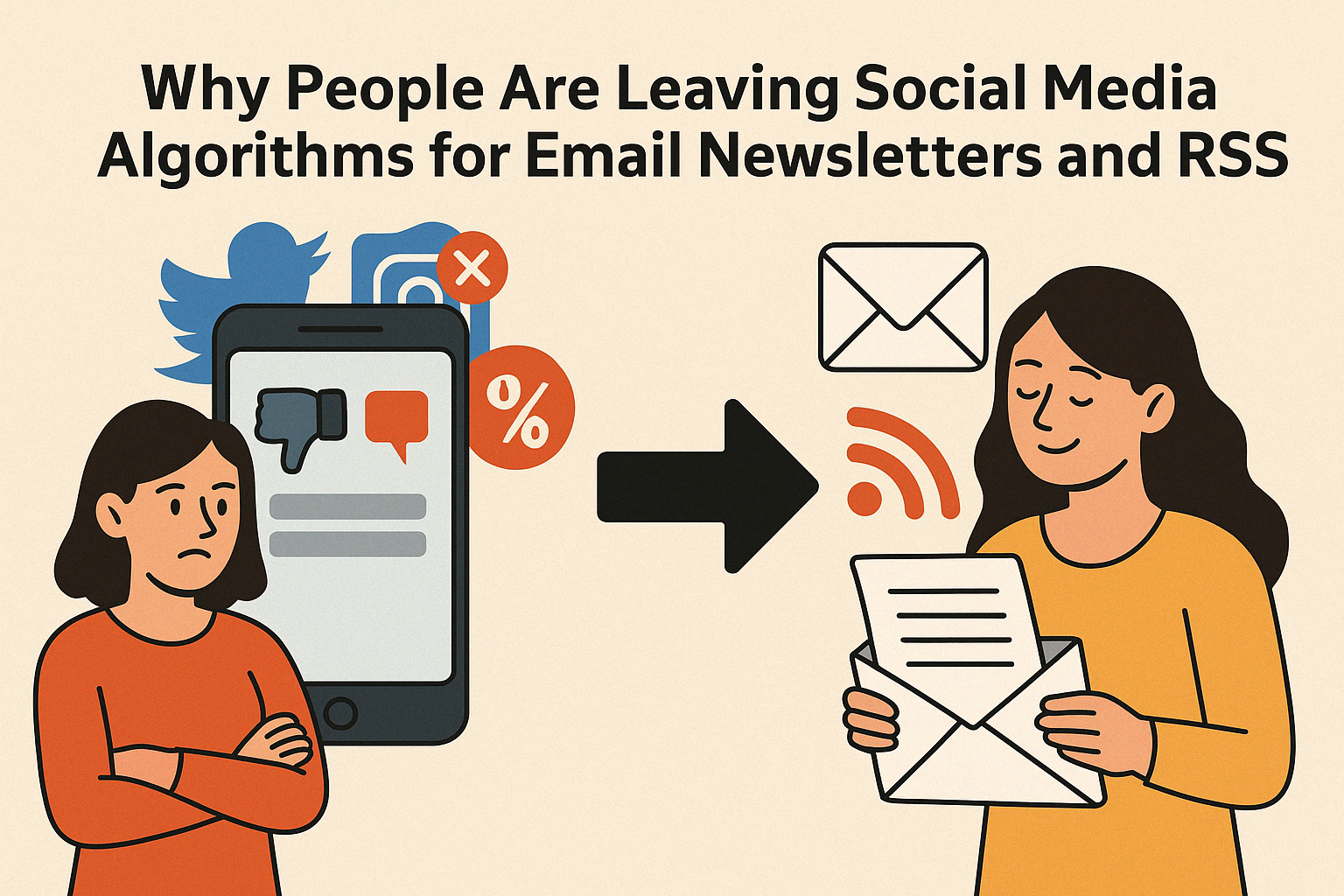
Why People Are Leaving Social Media Algorithms for Email Newsletters and RSS
In the early 2010s, social media was heralded as the future of information sharing—a real-time, personalized feed of news, ideas, and conversations. Platforms like Facebook, Twitter (now X), and Instagram promised a more democratic internet, where content from friends, journalists, and thought leaders would flow seamlessly into your timeline. But over the years, what began as a revolutionary pipeline for daily updates has transformed into a crowded, manipulated stream governed by opaque algorithms, endless ads, and click-chasing content.
Today, a growing number of people are stepping off the algorithmic treadmill and returning to two deceptively simple technologies: email newsletters and RSS feeds. In an ironic twist, the inbox and the RSS reader—once considered relics of the early web—are being rediscovered as sanctuaries of intentional, high-quality information. But what’s fueling this migration away from algorithm-driven feeds and back to more user-controlled channels?
1.
Algorithm Fatigue and the War on Attention
At the heart of this shift lies a deep exhaustion with how social media platforms manipulate our attention. Algorithmic feeds prioritize engagement over substance, often amplifying outrage, misinformation, and sensationalism simply because they keep users scrolling. For many, the experience of opening a social app has become more stressful than informative. The algorithm is no longer a curator—it’s a puppet master.
Email newsletters and RSS readers offer a calmer alternative. They don’t compete for your attention with a barrage of dopamine-hacking notifications or viral distractions. They arrive in structured ways—from a trusted source or directly from a feed—and can be consumed at your own pace. For the overstimulated digital citizen, both feel like a return to signal over noise.
2.
Control and Curation Over Chaos
One of the core appeals of these formats is control. When you subscribe to a newsletter or add a site to your RSS reader, you’re making a deliberate choice about the kind of content you want to receive. There’s no algorithm deciding what’s “most relevant” or profitable to show you. You build your own information diet.
On social media, even content from accounts you intentionally follow can be drowned out or reshuffled by the algorithm. Newsletters and RSS feeds break this cycle, letting you hand-pick your sources and build a feed that’s fully yours—clean, chronological, and ad-free (or at least far less intrusive).
3.
The Rise of the Creator-Writer Economy
Platforms like Substack, Beehiiv, and Ghost have empowered independent writers to monetize their content directly and build genuine communities. Writers who once depended on the social media firehose for distribution are now building loyal audiences via email and feed subscriptions. These platforms offer a low-friction way to share long-form ideas without character limits or algorithmic meddling.
For readers, this has created an ecosystem rich in niche, high-quality content—from deep dives on economics and politics to curated film reviews and personal essays. It’s not just about avoiding social media; it’s about discovering better content that speaks to your interests and values, not just your data profile.
4.
The Quiet Comeback of RSS
Alongside newsletters, RSS (Really Simple Syndication) feeds are quietly experiencing a revival. Popular during the early blog era, RSS allows users to subscribe to websites and receive content updates in real time through a feed reader—no algorithms, no ads, no tracking. Tools like Feedly, Inoreader, and even open-source options like Miniflux are becoming increasingly popular again.
RSS offers many of the same benefits as newsletters—direct content delivery, no interference, and full user control—but with a more centralized reading experience. Unlike newsletters, which pile up in your inbox, RSS feeds can be scanned in a unified interface, with filtering and tagging tools to streamline your content diet. For the information-savvy, RSS feels like reclaiming a long-lost superpower.
What’s more, the growing adoption of RSS among privacy-minded users aligns with broader digital trends: ad blockers, cookieless browsing, and a rejection of surveillance capitalism. In many ways, RSS is the antidote to the attention economy.
5.
Trust and Transparency Matter Again
In an era of declining trust in institutions and platforms, the personal nature of newsletters and the open architecture of RSS feel more transparent and authentic. You know who wrote the content. You know where it came from. And, crucially, you know why you’re seeing it—because you subscribed.
Social media feeds are riddled with sponsored posts and algorithmic biases that can distort perception. Newsletters and RSS readers, by contrast, restore the old one-to-one or one-to-many relationship between creator and reader. Even in mass distribution, the format feels more direct, more honest, more human.
6.
Digital Minimalism and the Desire to Reclaim Time
The return to email and RSS is also part of a broader cultural trend: digital minimalism. As people reassess how they spend time online, many are choosing to limit app usage, remove notifications, and reduce dependency on the infinite scroll of social platforms. Newsletters and RSS feeds help foster more intentional reading habits. You can batch them, archive them, revisit them later. They don’t demand constant interaction or reward impulsivity.
In other words, these formats aren’t just different ways to consume content—they represent better ways to live online.
Conclusion: Less Feed, More Focus
The resurgence of email newsletters and RSS feeds represents more than a change in format; it’s a quiet rebellion against the attention economy and the manipulation of our digital experiences. People are hungry for substance, trust, and a sense of control. And in a twist of digital fate, the solutions lie not in flashy new apps, but in the steady pulse of the inbox—and the elegant simplicity of the feed.
What was once thought obsolete is now being reimagined as the future of mindful media consumption. And the message is clear: the best algorithm may be no algorithm at all.

 Playing with Sharp Objects.