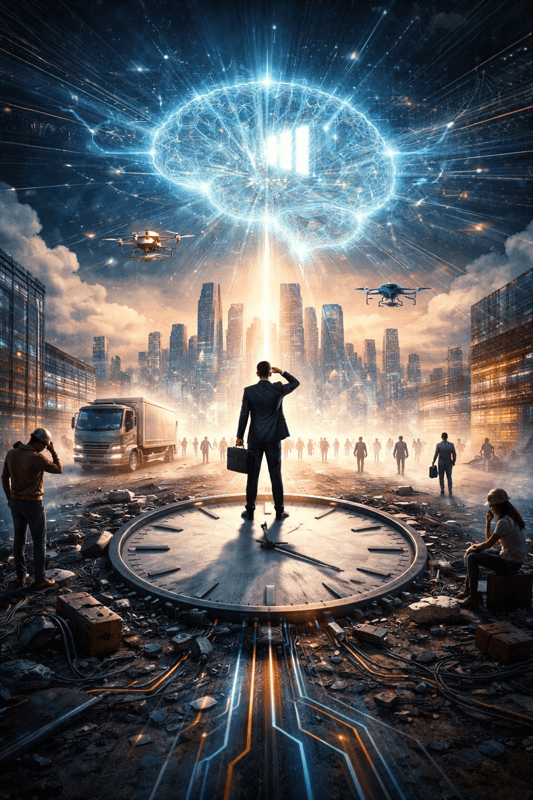
Or how we learn to compromise on AI
A decision that once took months now takes days. Production cycles that once unfolded over quarters collapse into weeks. Expectations are reset continuously, leaving little time to understand what has changed before it changes again. What once felt solid, including timelines, processes, and professional paths, has become unreliable. The ground is not disappearing all at once, but it is no longer holding still.
The most dangerous misunderstanding about artificial intelligence is not that it will replace jobs or automate creativity, but that the foundations we have built our lives upon will remain stable as it accelerates. AI is not a discrete technology with a bounded impact. Like the computer before it, and the internet shortly after, it will seep into every crevice of daily life. What we are seeing now is not maturity, but infancy. These systems will continue to improve, not linearly but relentlessly, the way Broadway in New York emerged from an old Wecquaesgeek footpath into a central artery once enough people began moving in the same direction. Evolution follows motion, not caution.
Business now moves at a pace that rewards speed above all else. Models leapfrog one another week to week. A new service becomes the next golden boy while yesterday’s reliable tools fade into obsolescence. New players flood the field as old ones quietly exit. This is celebrated as progress, even as it takes on the familiar shape of an arms race, in which standing still is indistinguishable from falling behind.
The institutions we rely on were not built for this tempo. Law, governance, labor markets, education, compliance, and trust were designed around human rhythms: deliberation, review, training, and oversight. Humans cannot scale as machines do, and these systems were never meant to. AI has not yet outpaced all of them, but that moment is close enough to feel. The result is not sudden collapse, but something more corrosive: the slow realization that the structures meant to stabilize society are becoming slower, weaker, and less reliable than the systems they are supposed to constrain. This is a return to days of malaise caused by desynchronization rather than any failure or moral decay.
What AI is actually doing is accelerating one load-bearing pillar of society so aggressively that the relative floor beneath everything else is dropping. This is less like a dramatic explosion than a structural failure: discovering too late that the ground floor of your home has been rotting while new stories were being added above it. You do not notice the problem until the stress reveals it. Speed feels like free progress, an easy win, and we place extraordinary weight on that promise. But speed creates pressure. It exposes fragilities we did not know we were depending on. And as more of this acceleration becomes pay-to-play, where money translates directly into tokens and capability, those without resources find themselves standing on increasingly unstable ground, watching the floor sink out from under them.
A Scaffolding Vanished
The floor is dropping because one segment of the system is no longer waiting for the rest to move. This is not a moral indictment of society, nor a story about laziness or incompetence. Every technological revolution creates imbalance. If horses could speak, they would tell stories of how central they once were to daily life, and how quickly the world of transportation reorganized without them. Entire industries that served buggy whips and saddles did not fail because they lacked skill or effort, but because the world reorganized around a new tempo. This moment is different in scale and scope, but not in kind.
What makes AI uniquely destabilizing is not intelligence alone, but time compression combined with global reach. Previous revolutions unfolded unevenly, first felt locally and only later propagated outward. AI does not spread that way. Its effects arrive nearly everywhere at once, carried by global markets that reach into the smallest bazaars. AI does not simply allow people to do more; it allows them to do things faster than surrounding systems can respond. When action accelerates faster than coordination, stability lags behind progress, and that gap is not distributed evenly. The regions and populations least able to absorb shock feel it first and longest.
Much of the public conversation frames AI as a productivity story: more output per worker, faster iteration, lower marginal cost. That framing is comforting because it fits neatly inside economic models we already understand. We equate speed with success. Time equals money. Faster must be better. But AI does not politely wait for society to catch up. It immediately resets expectations to faster delivery, fewer people, lower costs, instant answers, continuous availability, and minimal tolerance for failure. This desynchronization is already visible: organizations shipping features faster than they can secure them, regulators chasing technologies they barely recognize, labor markets demanding skills before education systems can produce them, and public discourse struggling to keep pace with the velocity of change it is asked to judge. Coordination cost, the invisible glue of communication, verification, trust, and shared understanding, still takes time. AI can reduce the time required to act, but it does not reduce the time required to understand the consequences of action. Acceleration becomes an implicit tax on everything else.
An economist might argue that this is simply productivity growth playing out as it always has. Labor markets adjust. Wages signal scarcity. Displaced workers eventually find new roles, a view history supports only up to a point. What is different now is velocity. AI does not merely change which skills are valuable; it changes how quickly those valuations shift. Workers are asked to retrain for roles whose half-lives are unclear. Firms demand adaptability without offering predictability. Education systems are expected to produce skills that may be obsolete by the time students graduate. Wage signals fail when uncertainty overwhelms planning horizons. Retraining fails when timelines exceed patience. Labor mobility fails when transition costs are borne almost entirely by individuals.
The result is not efficient reallocation. It is risk aversion, inequality, and burnout. A programming student who began training four years ago now enters a market that not only demands experience, but is simultaneously flooded by thousands of highly skilled workers shed by tech giants. More subtly, many of the roles being eliminated were not about raw output, but about stabilization: quality control, institutional memory, ethical friction, and translation between technical systems and human values. Removing those functions without replacing them creates organizations that appear efficient but are structurally fragile. The era of white-gloved corporate stability is ending. The economy may continue to grow even as its shock absorbers disappear, but it will leave scars.
This unease is not limited to those displaced by the shift. Even the people closest to the technology feel it. As Andrej Karpathy recently wrote:
“I’ve never felt this much behind as a programmer. The profession is being dramatically refactored as the bits contributed by the programmer are increasingly sparse and between. I have a sense that I could be 10X more powerful if I just properly string together what has become available over the last ~year and a failure to claim the boost feels decidedly like skill issue. […] Clearly some powerful alien tool was handed around except it comes with no manual and everyone has to figure out how to hold it and operate it, while the resulting magnitude 9 earthquake is rocking the profession. Roll up your sleeves to not fall behind.”
This is not panic; it is recognition. Spencer Johnson’s Who Moved My Cheese? became popular because it captured a recurring truth of modern work: the environment changes whether you consent to it or not. What AI adds is not novelty, but speed. The cheese does not merely move but relocates repeatedly before adaptation is complete.
The technical gap is widening just as quickly. In software development, the rise of “vibe coding” has been accelerated by tools for orchestrating agents, including a new system called gastown. Given enough money and tokens, a single programmer can now perform work that once required an entire department. Even within computing, the difference between those who can afford to orchestrate intelligence and those who cannot is expanding at a pace that feels seismic. Access is no longer just about skill; it is increasingly pay-to-play.
Looking further ahead, the destabilizing potential does not stop here. If today’s AI systems compress time within existing computational limits, their eventual coupling with quantum computing would compress it again, this time by collapsing classes of problems that currently remain intractable. Whether or not that convergence proves to be the path to artificial general intelligence, it would further widen the gap between systems that can act and institutions that can meaningfully respond.
The scaffolding is not failing because it was poorly built. It is failing because the structure it was meant to support is accelerating away from it.
No Rest for the Automated
There is a persistent belief that AI deployment can be paused until society is ready, and that if we slow down enough, institutions will adapt organically. The belief is comforting. It is also unrealistic.
Competitive pressure ensures deployment. Curiosity ensures experimentation. Waiting for society to catch up before unleashing AI is implausible, not because of bad intentions, but because no actor has the incentive or authority to stop. If AI accelerates one pillar of society, every stabilizing function must accelerate as well or risk becoming a liability. Historically, sitting still and puzzling out a response has never been how societies absorb technological change. It will not work here.
This is not a call for reckless adoption. It is a recognition that AI-accelerated systems cannot be governed, secured, or audited with human-speed processes alone. In practice, giving people AI tools is insufficient. They must understand what those tools are for. Hackers already use AI to discover vulnerabilities faster than humans can patch them. Disinformation spreads faster than fact-checking can respond. Financial anomalies propagate faster than audits can detect them. In each case, the actors moving fastest have already identified their use cases. The stabilizing functions, including security, governance, compliance, auditing, risk management, and operations, face the same structural reality: they must operate at the speed of the systems they oversee.
That means these functions need AI as core infrastructure, not as a bolt-on. Security needs AI to enforce boundaries continuously. Governance needs AI to monitor decision flows in real time. Compliance needs AI to generate evidence as a side effect rather than an afterthought. Auditing and review need AI to surface patterns humans would never see unaided. Communication needs AI because shared understanding no longer scales linearly with complexity. This is not techno-solutionism; it is mechanical necessity. Once one gear spins faster, the rest must synchronize or shear off.
What Now
The floor is dropping faster than society is raising everything else, but that does not mean collapse is inevitable. What is at risk is permanence. If stabilizing institutions fail to adapt in time, trust erodes, informal workarounds replace formal safeguards, and fragility becomes normalized. Once that happens, rebuilding the floor becomes exponentially harder.
The future is not predetermined, but it is path-dependent. We can treat AI as a force that demands structural adaptation rather than cultural panic. We can invest in AI-augmented institutions, not just AI-accelerated businesses. We can value resilience alongside speed and durability alongside novelty. Steve Yegge has argued for these positives in concrete, systems-level terms, which is very inspiring.
Or we can continue celebrating how fast we can move while quietly losing our footing. The floor does not have to keep dropping. But it will do so irreversibly unless we build something strong enough to stand on.


 Playing with Sharp Objects.
One response to “The Floor Is Dropping”
Great metaphor.